
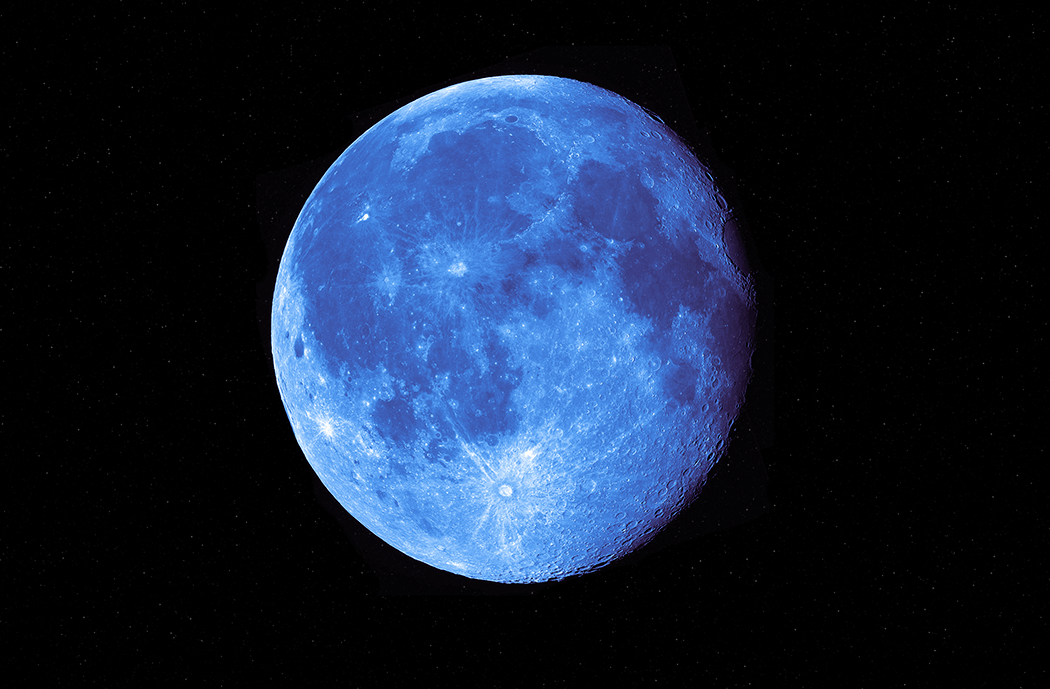
We’ve all heard the phrase “once in a Blue Moon”, but how many of us actually know what a Blue Moon is, and why it happens? Dr Mark Gallaway, a UK-based astrophysicist, astronomer, author, broadcaster, science communicator, and planetarium owner, is here to explain.
What is a Blue Moon?
Traditionally, the four astronomical seasons are divided by the two equinoxes and the two solstices. The Moon takes about 29 and a half days to go from full Moon to full Moon, so in a season of roughly three months, there are usually three full Moons. Occasionally, however, a season contains four full Moons. In that case, the third full Moon of the season is called a Blue Moon. This is the older, seasonal meaning of the term, and it happens roughly once every two and a half to three years.
Does the moon turn blue during a blue moon?
The more common modern meaning is simpler: a Blue Moon is the second full Moon in a single calendar month. These monthly Blue Moons are slightly more common than seasonal Blue Moons, occurring about once every 2.4 years. In neither case does the Moon actually turn blue. The Moon can, very rarely, appear blue because of particles in the atmosphere. One famous example occurred in late September 1950, when smoke from the enormous Chinchaga fire in Alberta and British Columbia spread across the atmosphere and produced reports of blue Suns and blue Moons.
An even more famous example followed the eruption of Krakatoa in August 1883. Fine volcanic particles high in the atmosphere scattered the light in such a way that the Moon was reported as appearing blue or green in some parts of the world for months afterwards. You may also have heard the term “supermoon”. The Moon’s orbit around Earth is slightly elliptical, meaning that it is closer to us at some points in its orbit and farther away at others. The closest point is called perigee, and the farthest point is called apogee. When a full Moon occurs close to perigee, we get what is popularly called a supermoon.
The media often makes a great fuss about supermoons, but in reality, the difference is modest: a supermoon appears only about 7% larger than an average full Moon, and most people would struggle to notice the difference without a direct comparison. This is not the same effect as the Moon looking enormous when it is near the horizon. That is an optical illusion called the Moon illusion — in other words, your brain is messing with you.
Explaining the upcoming Micro Blue Moon
Just as we get supermoons, we also get micromoons. These occur when the Moon is full while near apogee, its greatest distance from Earth. A micromoon appears about 7% smaller than an average full Moon. On 31 May 2026, we get a rare combination: a Blue Moon that is also a micromoon. It is a Blue Moon because it is the second full Moon of May, and a micromoon because it occurs when the Moon is close to apogee.
So, if the sky is clear on 31 May, step outside and have a look at our nearest neighbour doing something quietly unusual. It will not look blue, and it probably will not look dramatically smaller, but it will be a lovely little calendar trick played out in the sky.