
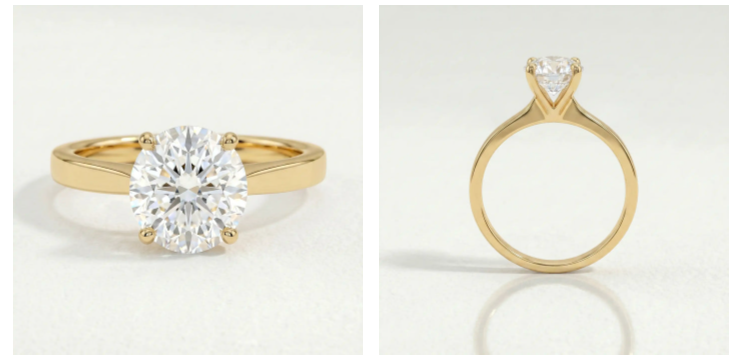
From above, you see a round stone and a simple gold band. Turn the ring slightly, and curved metalwork opens beneath it like the petals of a small flower. A tulip setting can give a familiar solitaire a detail that feels surprisingly personal.
AD | advertorial feature.
It is an appealing option if you love floral jewellery but prefer a simple outline across the top of your hand. The flower sits within the structure holding the stone, ready to appear as the ring turns.
The flower is in the setting
“Tulip” describes the shape of the mounting, rather than the gemstone’s cut. Curved supports suggest petals cupping the stone. The arrangement varies between designs, so look at the actual metalwork rather than expecting every ring with the name to look alike.
Among Lily Arkwright’s engagement rings, Lottie offers an example with a round lab-grown diamond in an 18ct yellow-gold four-claw setting. Its tapered tulip-style mount gives the stone a curved support beneath it, while the band remains plain.
Lottie in 18ct yellow gold, front (left) and side (right). The tulip mounting appears beneath the diamond. Product photographs show a 2ct lab-grown centre. Images: Lily Arkwright; not actual size.
Claws, also called prongs, secure the gemstone at its edge. In a tulip-style mounting, the prongs and supporting metalwork can curve upwards like petals. GIA’s setting guide explains the distinction between how a stone is secured and the ring’s wider design.
Follow the curves beneath the stone
Look at where the petal-like lines begin and how they open as they rise. Do they meet close beneath the stone, or leave a more open shape? Are the curves narrow and elongated, or fuller and rounder? Those differences can make a tulip-style mount look like a closed bud or a more open flower.
The amount of floral detail you see depends on the design and viewing angle. Compare a profile photograph with an angled view to see how those lines appear as the ring turns.
Choose the colour of the petals
Yellow gold can make the petal-like lines easy to pick out against a pale stone. White gold or platinum creates a paler outline, while rose gold brings pink into the curves. Compare which colour helps you see the floral shape you enjoy.
Look at the whole mounting when comparing colours. A ring may combine a yellow-gold band with a white-metal head, the part holding the stone. In that case, the band colour alone will not tell you what colour the petals will be.
Let the detail fit your own style
If you enjoy jewellery with small, unexpected details, a tulip mounting offers something to discover beneath the stone while keeping the band simple.
Try it with the rings, bracelets or watch you already wear. Look at your whole hand first, then turn it to see the floral shape. You may enjoy how discreetly it becomes part of your usual look, or decide you want a more visible flower. That is useful to know before choosing.
Enjoy the flower as part of the whole ring
Compare the complete profile: how high the head sits, how it joins the shoulders and how much of the flower remains visible on your hand. “Tulip” describes a shape, not a fixed height.
The curved supports also secure the stone. The National Association of Jewellers flags loose stones and worn or damaged claws for professional attention. Ask the jeweller what needs inspecting on the particular design.
Then bring your attention back to the flower. You might love the plain band and round stone first, with the tulip as a detail you discover afterwards. Or those little curves might be the reason this ring feels right. Either way, it is worth choosing a design you enjoy from the side as much as from above.


